USDA wants to strip roadless protections from 9 million acres of the Tongass. Here's the history, what's at stake, and how to comment by October 6.
Sitka Sound at sunset with Mt. Edgecumbe reflected in still water. Photographed in late August.
From Ben
We run small wildlife boat tours from Crescent Harbor, six guests at a time, with a captain and a naturalist who know this coast. Whether you have a few hours in port, are traveling with kids, are staying a few days without a ship, or want a private week with your own boat and crew, we can plan it. Pack your sense of wonder.
Lines on a map only hold as long as people speak up for them.
If you've ever visited Sitka or Southeast Alaska, you probably remember the moment the wonder of it hit you. Maybe it was a whale surfacing beside a boat, a brown bear working a salmon stream, bald eagles soaring overhead, or an old-growth forest dropping straight into the sea. Places like this are rare in our world today. They are the reason millions of visitors come here each year.
This ecosystem is still intact for a simple reason: it was never carved up and sold. Almost all the land around communities like Sitka, Kake, Pelican, Wrangell, Petersburg, Juneau, and Ketchikan is public, part of the Tongass National Forest. At 16.7 million acres, it's the largest national forest in the United States. It doesn't belong to a person or a corporation. It belongs to all of us.
And what we own together is rare. It's one of the last places on Earth where bears are still the apex predator, where all five Pacific salmon species still run wild, and where rain flows from frozen peaks to the ocean without roads, factories, farms, or culverts in its way. A kid in Ohio, a grandmother in New York, and a fisherman in Sitka all share in this wild legacy.
But this isn't a story about what we have. It's about what we might lose.
Much of what makes this place extraordinary depends on a rule most people have never heard of: the 2001 Roadless Rule. It keeps new road networks, industrial logging, and large-scale mining out of roughly 45 million acres of national forest across the country. More than 9 million of those acres are here in the Tongass.
Right now, the U.S. Department of Agriculture is proposing to remove these protections nationwide. The public comment period closes October 6, 2026. This is public land. You have a right to comment on it, whoever you are and wherever you live. I'm asking you to take five minutes and use it.
Use the Sitka Conservation Society comment tool or go directly to regulations.gov, docket FS-2025-0001. Write in your own words. Then come back for the story.
If you have more time, here's the story behind it. I've spent the better part of two decades making conservation films in the Tongass and hundreds of hours interviewing the people who live here. This is what they taught me.
I first came to Sitka in 2007 as a film student from Texas, hired by the Sitka Conservation Society (SCS) to tell the story of how a small group of locals protected a stretch of coast called West Chichagof. I assumed the national forest around me was like a national park, protected for its beauty.
One of my first interviews set me straight. A regional forester in the full green Forest Service uniform, known as the pickle suit, explained that national forests are managed for multiple use. They exist to supply the country with natural resources, which is why they sit under the Department of Agriculture. Their founding principle came from Gifford Pinchot, the first chief of the Forest Service: the greatest good of the greatest number in the long run.
In the early 1900s, the greatest good of a forest meant one thing: lumber. Trees were a crop, like corn and soybeans. Remember that phrase. This whole fight still comes down to who gets to define it.
The Tongass became a national forest in 1907, and the Forest Service tried to build a pulp industry here almost from the start. For decades, no company would take the bet. Then Washington changed the math. A pulp mill opened in Ketchikan in 1954, and in 1959 a Japanese company opened another just outside Sitka. Sitka's population jumped 63 percent as roughly 500 people went to work there. Almost overnight, a fishing town became a mill town.
Each mill was backed by a 50-year federal contract. Together they committed more than 13 billion board feet of old-growth timber, and for decades nearly every major timber sale in the forest went to those two companies. The motive was never really lumber. In the early Cold War, Washington wanted Alaska populated, and it wanted Japan, cut off from its old timber sources in now-Soviet territory, anchored to the West. The State Department itself blessed the Sitka deal.
The economics never worked on their own. The Tongass is a maze of steep islands reachable only by boat or plane, and Sitka gets more than 100 inches of rain a year. So the public paid. The government credited the mill companies dollar for dollar for the logging roads they built. Remember that math. It sits at the center of today's proposal.
The logging spread fast. For many Sitkans, the tipping point came in the 1960s, when the Starrigavan Valley, a salmon stream and hunting ground ten minutes from town, was clearcut.
Chuck Johnstone saw it. He worked at the pulp mill himself for fifteen years. In 1967, he and his wife Alice met two teachers at a Sitka High School parent night who shared their worry. "They were just wiping it out," Chuck remembered. With their friends Jack and Sasha Calvin and a few neighbors, they formed the Sitka Conservation Society. Their goal sounded absurd: ask Congress to protect West Chichagof under the brand-new Wilderness Act, before the mill "turned all our trees to pulp," as Alice put it.
Speaking up meant standing against the town's biggest employer and most of their neighbors. The Forest Service turned them down flat. For years, almost nobody stood with them.
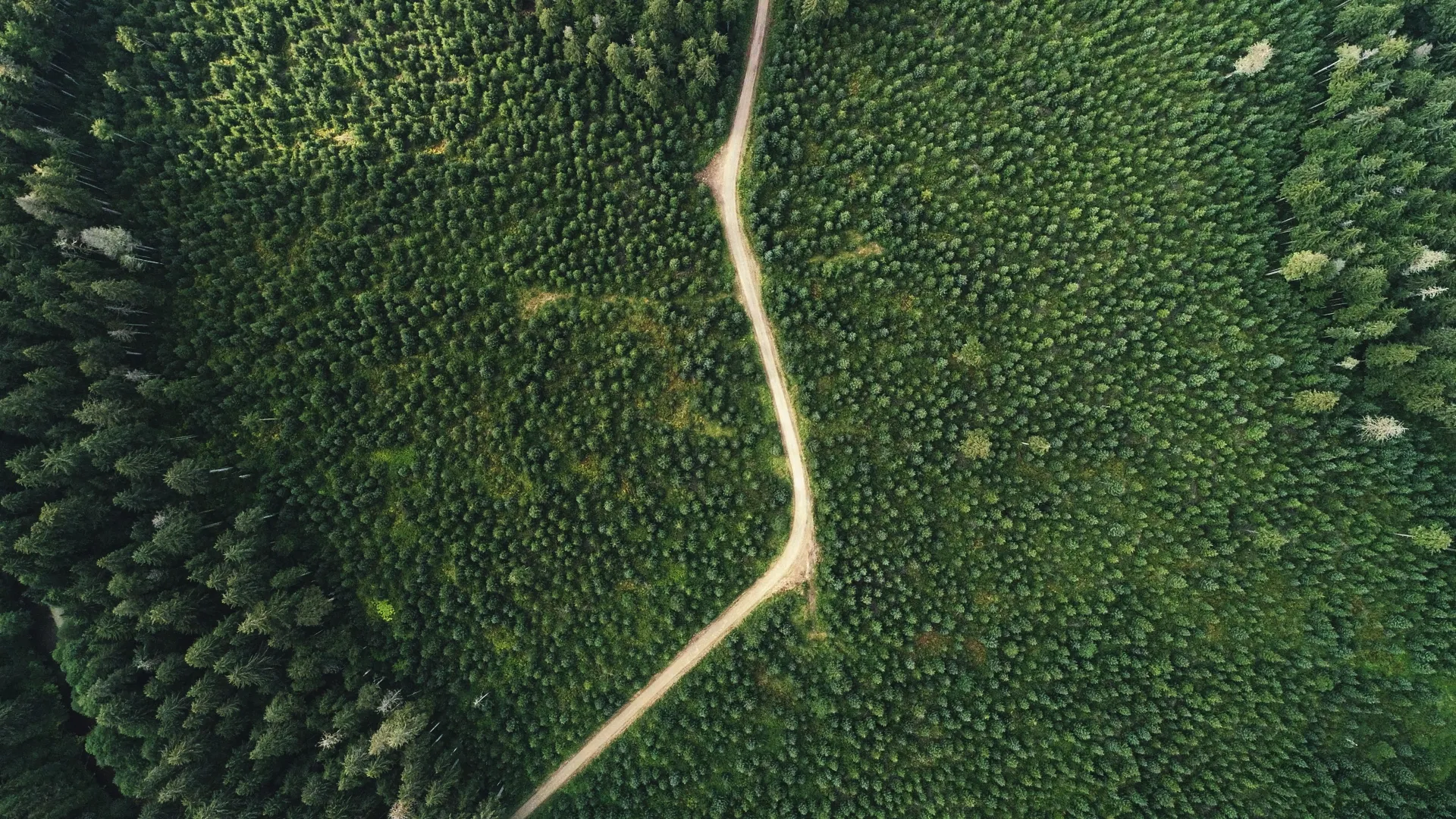
They kept at it for thirteen years. In 1980, Congress passed the Alaska National Interest Lands Conservation Act (ANILCA), the largest single act of land conservation in American history. In the Tongass, it created 5.4 million acres of wilderness, including West Chichagof. Today it is some of the wildest coastline in North America. It exists because a handful of people refused to stop speaking up.
But the same law carried a catch. It guaranteed the timber industry 4.5 billion board feet per decade, backed by at least $40 million a year from the Treasury. One signature saved a coastline and subsidized the cutting of the rest.
Analysts had already shown that Tongass timber sold for less than it cost the government to offer it. Government auditors soon confirmed it. From 1981 to 1986, the fund spent $257 million. More than half went to roads and timber sales nobody bought. In 1986 alone, the program lost $22 million.
Salmon paid too. For decades, no rule required loggers to leave trees along salmon streams. At Maybeso Creek on Prince of Wales Island, the first large-scale clearcut in Southeast Alaska, researchers documented logging debris choking stream channels and a surge in landslides. Poorly built road crossings blocked young salmon from swimming upstream.
In 1990, the Tongass Timber Reform Act ended the guarantee and banned logging within 100 feet of major salmon streams. The Sitka mill closed in 1993. Ketchikan's followed in 1997.
During my last summer filming for SCS, I camped under a tree in Tebenkof Bay Wilderness that was more than fourteen feet across. That one tree had shaded a salmon stream for more than half a millennium. It had filtered rain, stabilized the banks, covered deer while they foraged, and given bears a home. On the timber ledger, as pulp, it was worth almost nothing. That night, this stopped being history for me.
The mills were gone, but their roads were not. Logging had carved more than 4,000 miles of roads into the Tongass, and taxpayers kept paying to maintain them. The same story was playing out nationwide. By the late 1990s, the national forests held more than 380,000 miles of road, enough to circle the Earth fifteen times, with an $8.4 billion maintenance backlog. The agency was building roads it could not afford to maintain, into timber it could not sell.
Meanwhile, what people valued in these forests was changing. A century earlier, Pinchot's greatest good had meant lumber. Now it meant clean water, fishing, hunting, and wild country. The forests were worth more alive than as raw material.
In 1999, the Forest Service's own chief paused new road building in the wildest remaining forests. The proposal that followed drew the largest response in rulemaking history: more than 600 public hearings and 1.6 million comments, roughly 95 percent in favor of protection. In January 2001, the government adopted the Roadless Rule. More than 9 million acres of the Tongass gained protection.
Even the Forest Service was changing. The agency SCS had once fought in hearings and in court began celebrating the Tongass as a home for wilderness. Its own scientists concluded that salmon may be the most valuable thing the forest grows. By the agency's count, the Tongass produces roughly a quarter of all salmon harvested in the northeastern Pacific. Restoration crews began repairing damaged streams and replacing culverts that had blocked fish for decades. Tourism grew. By 2017, it felt like we were finally moving past the timber wars.
But not everyone had moved on.
The push to undo the Roadless Rule never went away. Every Alaska governor since 2001 had lobbied Washington to rescind it. In 2018, during the first Trump administration, that campaign found a willing partner. The federal government began work on a rule to strip the Tongass of its roadless protections, at the State of Alaska's request. The push did not come from Southeast Alaska's fishing fleet or its tourism operators.
To understand why, you have to understand a view of these forests that runs deep in Alaska politics. Nearly all of Southeast is federal land. Senator Lisa Murkowski has pointed out that less than one percent of it is privately held. To many leaders, a forest protected from roads is a resource locked away, value the state is being denied. Timber, minerals, and roads produce jobs you can count and revenue you can tax. Clean water, salmon runs, and wild country produce value too, but it's spread across thousands of fishermen, guides, and families. It never shows up as a single line in a budget. It's Pinchot's question all over again: who gets to define the greatest good?
In 2019, the headline landed: "Trump pushes to allow new logging in Alaska's Tongass National Forest." The order came from the very top, after the governor raised it with the President aboard Air Force One.
But no administration can rewrite a rule like this with a signature alone. Federal law requires the government to propose the change in public and take comments from anyone in the country. It was the same comment period that is open right now.
When the Forest Service analyzed the unique letters it received, 96 percent supported keeping roadless protections on the Tongass. Fewer than 1 percent supported a full exemption.
The strongest voices were the oldest ones. Six tribal governments joined the process as cooperating agencies, official advisors to the Forest Service: Angoon, Hoonah, Hydaburg, Kake, Kasaan, and the Central Council of Tlingit and Haida. All six came to defend the rule. One by one, all six withdrew. Their input was being ignored, and their presence was being used to legitimize a decision already made.
Joel Jackson, president of the Organized Village of Kake, was a former logger who spent more than thirty-five years on his tribal council. By about the fifth meeting, he said, the agency announced it was lifting the rule no matter what the tribes said. His father taught him not to call it subsistence. It is a way of life. "Ancient trees in the Tongass forest know our ancestors and current communities' names," he wrote. Joel died on August 30, a few weeks before I wrote this. This comment period is one more chance to stand up for what he stood up for his whole life.
In October 2020, the government exempted the entire Tongass. Ninety-six percent of the letters, six tribal governments, the fishing fleet. None of it stopped the signature.
These protections are lines on a map. Unless enough of us keep insisting they matter, a change in politics can erase them.
But everything the public put on the record was still there. Five of the tribes sued. In January 2023, protections came back. The record is a big part of why.
Comments don't always win the day they're counted. They become the official history of what the public asked for, the evidence courts examine, and the foundation the next administration builds on. Speaking up worked in 1980. It worked in 2023. It is the only thing that has ever worked for this forest.
Which brings us to right now. USDA is proposing to rescind the Roadless Rule nationwide: roughly 45 million acres of national forest, including every roadless acre of the Tongass. Even the so-called compromise alternative removes every roadless acre of the Tongass.
Roads are what make industrial extraction possible. Once a road network goes in, old-growth logging and large-scale mining follow it into country that has never had either.
The public has already spoken once. The first round of comments drew more than 600,000 responses, and more than 99 percent opposed repeal in an independent analysis. The government's own draft environmental impact statement concedes the point, recording that scoping comments ran 99 to 1 against rescission (p. 19).
The 2001 rule took two years and 600 public hearings. The proposal to erase it has scheduled no general public hearings anywhere in the country, only a handful of subsistence hearings required by law in Alaska. Written comments are the one way the public gets heard this time.
Here is the strangest thing about this proposal: the case against it is written inside it. Every rulemaking comes with a draft environmental impact statement, the government's own analysis of what the change would do. You don't have to take my word for anything in this section.
The rule has never banned all roads. Roads for public safety, utilities, community needs, and existing mineral rights have always been allowed. What it blocks is new road networks pushed into untouched country for industrial logging and mining, usually at taxpayer expense.
Prince of Wales Island is the most heavily logged and roaded island in the Tongass. If roads created prosperity, it would be the busiest place in Southeast Alaska. When I filmed there, I found a few small towns, a handful of lodges, one place to eat, and thousands of miles of old logging roads going back to forest. The prosperity never came.
Now look at the government's own math. The draft EIS estimates repeal might generate $5 to $11 million a year in timber revenue nationwide, and states plainly that the economic impacts "are not expected to be substantial overall" (p. 220). It puts road construction costs in Alaska at four to five times higher than the rest of the country (p. 40), on top of a roughly $7 billion national backlog of road maintenance (p. 44). This is the pulp-era math again: public money for roads, to reach timber the market does not want. In the 1980s, government auditors caught it. This time, the agency published it itself.
Remember Pinchot's standard: the greatest good of the greatest number in the long run. The real uses of the Tongass today are fishing, tourism, recreation, hunting, subsistence, clean water, and the carbon these old trees hold. Fishing and tourism support roughly a quarter of the jobs in Southeast Alaska. Timber is under 1 percent. Managing this forest for what it actually provides is the greatest good of the greatest number in the long run.
The Tongass is a temperate rainforest. Parts of it see more than 100 inches of rain a year. The Roadless Rule already allows fuel treatment, prescribed fire, and emergency road building when fire threatens public safety. And across three decades of U.S. wildfire records, ignitions were about four times more concentrated near roads than in roadless areas, because people start most fires.
The government's own draft EIS agrees. It reports that ignition density is dramatically lower in roadless and wilderness areas (p. 87). It admits that "a lack of roads has not prevented fire prevention or protection measures" (p. 105), and that new roads would mean more ignitions closer to communities, "where they could potentially cause more damage" (p. 104). Then comes the line that ends the wildfire argument for this forest: "there are no high-priority firesheds in Alaska" (p. 102).
The same document lists what repeal would bring: more human-caused fire, sediment in the water, fragmented habitat, harm to threatened and endangered species, damage to tribally important resources, and losses to recreation (p. 22). It warns that logging and road building "may significantly increase the frequency and severity of debris flows," meaning landslides (p. 111). And it concludes that keeping the rule "provides the greatest protection of water quality" (p. 122). That is not my case against this repeal. That is theirs.
USDA published an interactive map of every area covered by this repeal. Zoom in on Sitka and the shaded areas blanket all of Kruzof Island and most of Baranof. That is the skyline from the deck of my boat. The coastlines guests photograph and the streams where we watch bears nearly all sit inside the areas this proposal would strip. The only parts that stay protected no matter what are the wilderness areas earlier generations fought for: West Chichagof, and to the south Tebenkof Bay, where that fourteen-foot tree still stands. Everything else is one signature from open.
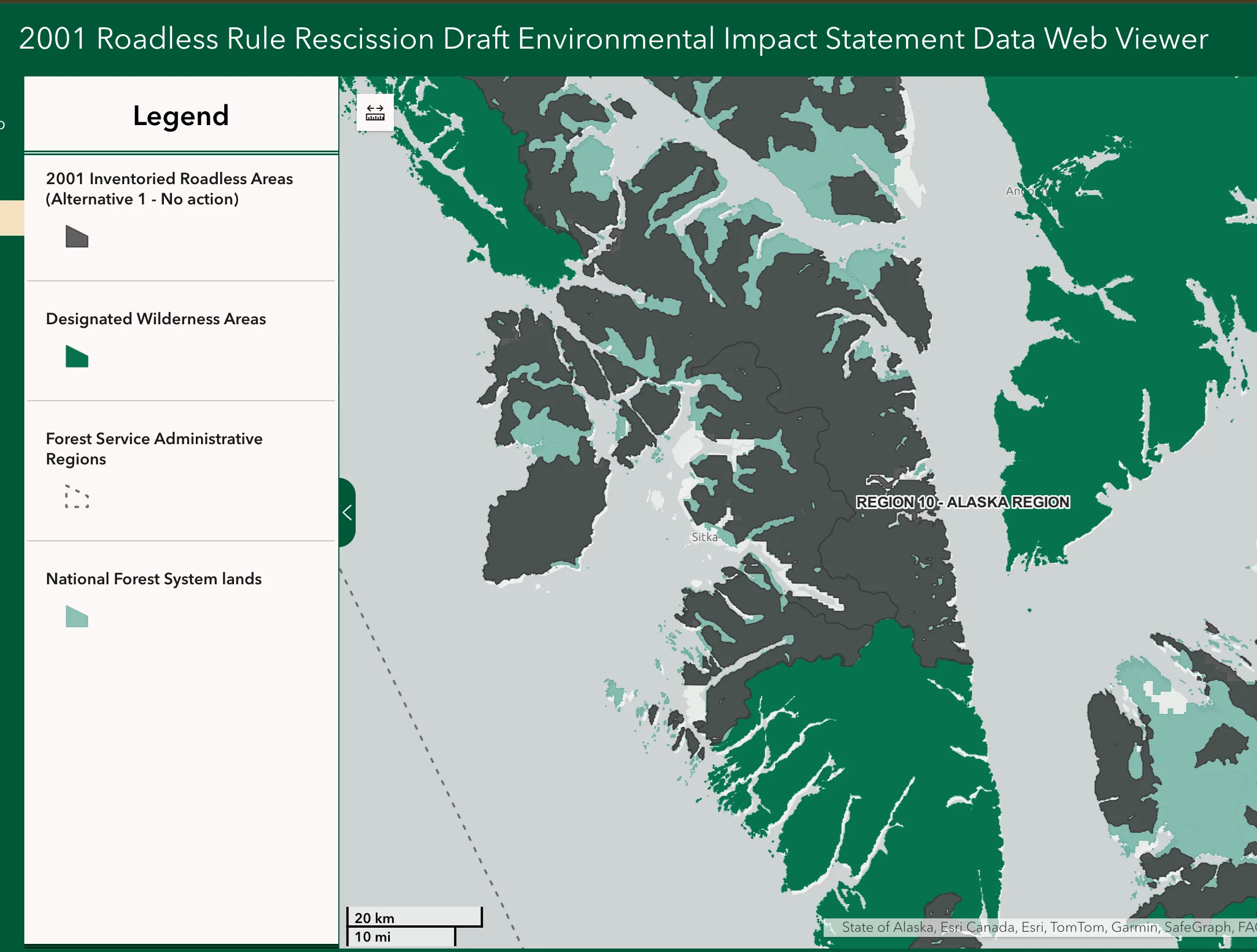
Caption: USDA's own map of the proposal. Grey areas are roadless lands that would lose protection, including all of Kruzof Island and most of Baranof. The dark green is designated wilderness, including West Chichagof, the wilderness Sitkans won in 1980. The difference between green and grey is people speaking up.
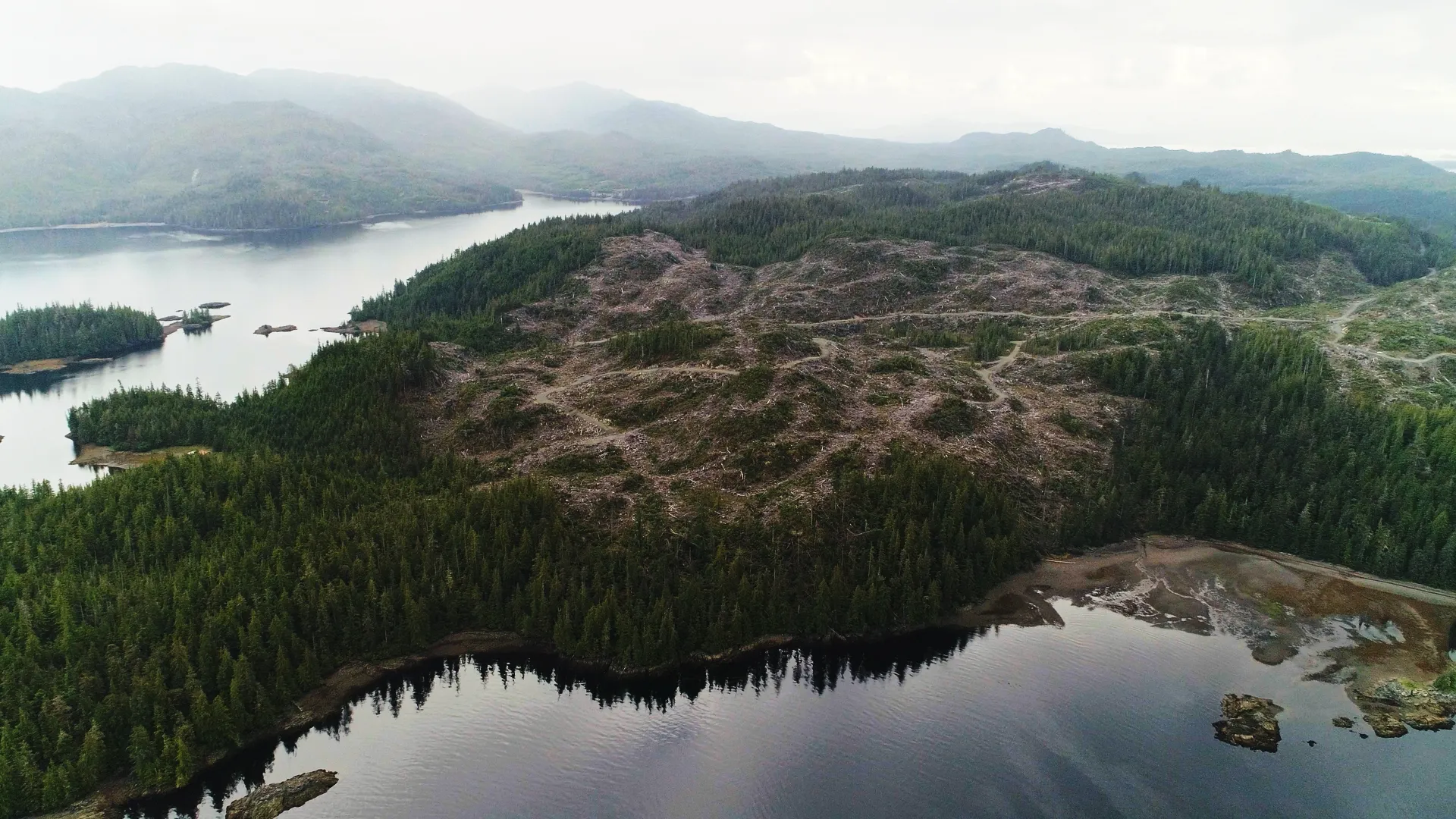
Kruzof shows both futures in one place. From the water it looks untouched, and Sitka residents still hunt, fish, and gather traditional foods and medicines in its roadless areas. But around Mud Bay are the roads from the last time politics decided this island's future. Kruzof was clearcut from the late 1950s through the 1970s. Decades later, those roads had eroded into salmon streams, and rusted culverts hung too high for fish to pass. Some of that forest still has not recovered.
The Forest Service itself has described the Tongass as the world's largest remaining intact old-growth temperate rainforest. But logging took the biggest trees first, the valley-bottom giants like the one I camped under in Tebenkof Bay. Much of what's left is in roadless country. A clearcut grows back as trees, but not as the forest that stood there for centuries. Every wild place we lose makes the rest rarer.
This is one of the last places where you can watch how life actually works and feel the wonder it inspires. If you have ever felt that in a wild place, the feeling was real. The protections behind it are only lines on a map, and they last only as long as people stand up for them.
Thank you to everyone who's come out on the water with me, and to everyone who speaks up for places like this.
Ben Hamilton, Sitka Wonders
I've been lucky to tell stories about this forest for nearly two decades, often for the Sitka Conservation Society and the Forest Service. If you'd like to go deeper, these are the films that taught me what I've shared here.
The 2001 Roadless Area Conservation Rule is a federal regulation that prevents new road construction and industrial logging in undeveloped areas of national forests, about 45 million acres nationwide. In the Tongass, it protects more than 9 million acres. It does not ban all roads: projects for public safety, utilities, and community needs have always been allowed.
The U.S. Department of Agriculture has proposed rescinding the Roadless Rule nationwide. Its preferred alternative would remove protections from every roadless acre of the Tongass. Even the "compromise" alternative removes every roadless acre of the Tongass.
The draft environmental impact statement acknowledges that fire ignitions are far lower in roadless areas, that the existing rule has not prevented fire protection work, that there are no high-priority firesheds in Alaska, and that repeal would risk water quality, wildlife, tribal resources, and recreation economies while producing timber revenue it calls not substantial.
October 6, 2026, through regulations.gov under docket FS-2025-0001.
Yes. Comments become part of the official administrative record. That record is what courts examine when a rule is challenged and what future administrations build on. The record the public built in 2019 helped drive the restoration of Tongass protections in 2023.
No. The Tongass is a national forest owned by all Americans, and anyone may comment, from anywhere.
Keep Reading
More stories from the coast, curated for travelers planning a meaningful Sitka experience.
.webp)